
Author name: brainixacademy01@gmail.com

Coaching Institutes / Competitive Exam Preparation

Class 11 Economics in 2026–27: Microeconomics vs Statistics — Key Differences, Study Tips and Exam Strategy

Starting Class 11 Economics can feel like entering a completely new subject. Unlike many subjects studied in school, Economics introduces students to concepts such as demand, supply, consumer behaviour, data analysis, averages, and economic decision-making. One common question students ask is: What is the difference between Microeconomics and Statistics for Economics? Which part is more difficult, and how should you prepare for both? The good news is that both areas become easier when you understand their purpose and practise regularly. In this guide, Brainix Academy explains the difference between Microeconomics and Statistics for Economics, highlights important topics, and shares a practical study strategy for the 2026–27 academic session. 1. What Is Microeconomics? Microeconomics studies the economic decisions of individual consumers, producers, and businesses. It examines how prices are determined, how consumers make choices, and how firms decide what to produce. For example, imagine the price of your favourite snack increases. You may decide to buy less of it or choose another product. Microeconomics helps explain such decisions. Important Microeconomics topics Depending on your prescribed syllabus, important areas may include: How to study Microeconomics Understand the concept first. Do not memorise a definition without knowing what it means. Practise diagrams. Learn demand and supply curves, label the axes correctly, and understand why curves move or shift. Use real-life examples. Relate concepts to prices, shopping decisions, production, and markets. Learn the assumptions. Many economic laws are explained under specific assumptions. Understand them before applying a concept. 2. What Is Statistics for Economics? Statistics for Economics involves collecting, organising, presenting, analysing, and interpreting numerical information related to economic questions. For example, a school may collect information about students’ daily travel expenses. Statistics can help organise the data and calculate an average expense. Statistics makes it easier to understand patterns and draw conclusions from data. Important Statistics topics Depending on your prescribed syllabus, important areas may include: How to study Statistics Learn formulas with meaning. Understand what a formula measures rather than memorising symbols alone. Solve numerical questions regularly. Start with basic examples and gradually move to more complex problems. Show your working. Write the formula, substitute the values, and calculate the answer carefully. Practise tables and graphs. Learn to read and present data accurately. 3. Microeconomics vs Statistics for Economics Feature Microeconomics Statistics for Economics Main focus Individual economic decisions Collection and analysis of data Learning style Concepts, explanations, diagrams Formulas, calculations, interpretation Example Understanding demand for a product Calculating average expenditure Common challenge Understanding relationships between variables Selecting and applying the correct formula Useful skill Logical reasoning Numerical accuracy and data interpretation Best preparation method Conceptual learning and diagram practice Formula revision and regular numerical practice Neither area is automatically easier for every student. If you enjoy logical explanations and diagrams, Microeconomics may feel more natural. If you enjoy calculations and working with numbers, Statistics may appeal to you. Both require conceptual understanding and consistent practice. 4. Which Topics Should Class 11 Students Practise First? Start by strengthening the foundational topics in both areas. Microeconomics priorities Statistics priorities Check the current syllabus issued by your examination board before finalising your chapter checklist. 5. A Practical Weekly Study Plan for Class 11 Economics You do not need to study Economics for several hours every day to build a strong foundation. A consistent routine can make revision more manageable. Day Study task Monday Learn one Microeconomics concept Tuesday Practise diagrams and application questions Wednesday Study one Statistics concept Thursday Solve Statistics numerical questions Friday Revise definitions, assumptions, and formulas Saturday Attempt chapter-wise questions Sunday Review mistakes and revise weak topics A focused session of 30–45 minutes can be a useful starting point. Increase your study time when a topic requires additional practice or examinations approach. 6. How to Write Better Economics Answers Good answer presentation helps you communicate your understanding clearly. For theory questions: For numerical questions: Practise using the command words in questions, such as explain, distinguish, calculate, analyse, and justify. 7. Common Mistakes Students Should Avoid Mistake 1: Memorising without understanding Memorisation alone makes it difficult to apply concepts to unfamiliar questions. Understand the logic behind each topic. Mistake 2: Ignoring numerical practice Statistics requires repeated practice. Solve a few questions regularly instead of leaving all calculations until revision time. Mistake 3: Drawing diagrams carelessly Incorrect labels or unclear curves can weaken an otherwise correct explanation. Practise diagrams neatly. Mistake 4: Skipping difficult topics Identify challenging chapters early and seek clarification before they create gaps in your understanding. Mistake 5: Studying only before examinations Regular revision helps you retain definitions, formulas, and concepts for longer. 8. How Brainix Academy Can Support Your Economics Preparation At Brainix Academy, students can work towards stronger conceptual understanding and more organised exam preparation. A structured learning approach can help students: Every student learns at a different pace. Consistent practice, appropriate guidance, and timely revision can help students become more confident with the subject. Frequently Asked Questions 1. Is Class 11 Economics difficult? It may seem unfamiliar at first because it introduces new concepts, diagrams, and numerical methods. Regular practice and clear explanations can make the subject more manageable. 2. Is Microeconomics harder than Statistics? It depends on your strengths. Some students find diagrams and economic reasoning easier, while others prefer numerical questions. Practise both before deciding which needs more attention. 3. Does Statistics for Economics require advanced mathematics? The level of mathematics depends on the topics prescribed in your syllabus. Students should be comfortable with basic arithmetic and practise the formulas and calculations included in their course. 4. How can I prepare for Class 11 Economics exams? Follow the syllabus, revise concepts regularly, practise diagrams and numericals, solve chapter-wise questions, and review mistakes. 5. Is Class 11 Economics useful for Class 12? Yes. Foundational concepts and analytical skills developed in Class 11 can support learning in Class 12 Economics. Conclusion Microeconomics and Statistics for Economics develop different but complementary skills. Microeconomics helps you understand economic decisions, while Statistics helps you analyse and interpret data. The

Coaching Institutes / Competitive Exam Preparation

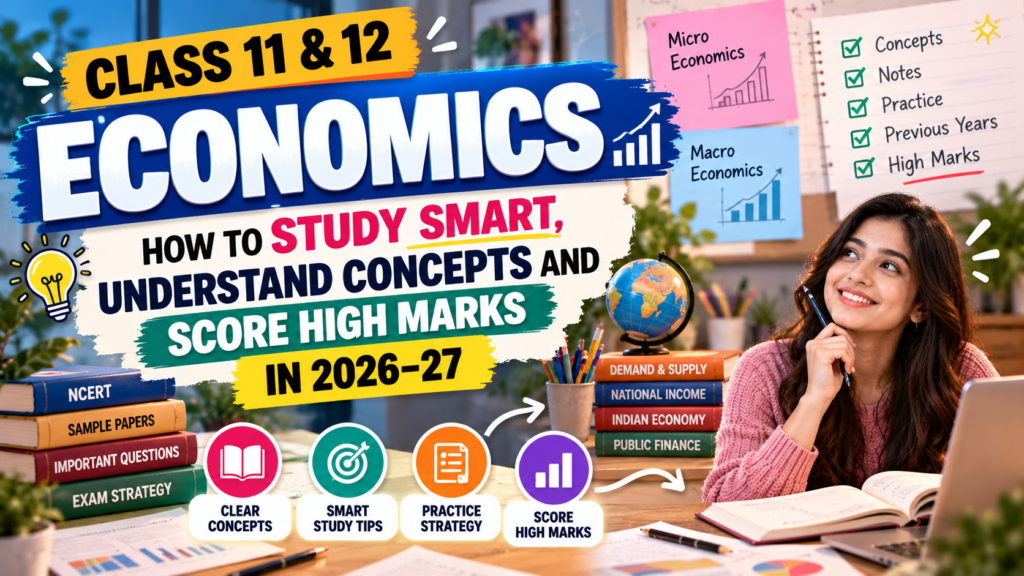
Class 11 & 12 Economics: How to Study Smart, Understand Concepts and Score High Marks in 2026–27

Economics is one of the most interesting subjects for students in Classes 11 and 12. It helps students understand how people make decisions, how markets function, why prices change, and how a country’s economy grows. However, many students find Economics challenging because it combines theoretical concepts, diagrams, numerical problems, definitions, and application-based questions. The good news is that you do not need to memorise every chapter word for word to perform well. With the right study strategy, regular practice, and conceptual clarity, you can improve your understanding and prepare effectively for school examinations and board exams. In this guide, Brainix Academy explains how students can study Economics smartly, avoid common mistakes, and build a strong foundation for academic success. 1. Understand the Economics Syllabus First Before starting your preparation, understand the syllabus prescribed by your school or examination board. Students studying under CBSE should check the latest official CBSE syllabus and examination guidelines for their class. Economics in Classes 11 and 12 generally covers different areas of the subject. Class 11 Economics Class 11 typically introduces students to two major areas: Statistics for Economics Introductory Microeconomics The exact chapter coverage should be checked against the current syllabus. Class 12 Economics Class 12 generally focuses on: Introductory Macroeconomics Indian Economic Development Understanding the syllabus helps you organise your preparation and allocate time to every unit. 2. Focus on Understanding Concepts, Not Rote Learning One of the biggest mistakes students make is memorising definitions and answers without understanding their meaning. Economics becomes easier when you connect concepts with real-life situations. For example, the law of demand states that, other things remaining constant, quantity demanded generally increases when price decreases and decreases when price increases. You can understand this concept through everyday examples. If the price of a product falls, consumers may be willing to purchase more of it. Similarly, when studying inflation, think about how rising prices affect household budgets and purchasing power. Study tip: After learning a concept, explain it in your own words and create one real-life example. If you can explain it clearly, you are more likely to remember it. 3. Learn Diagrams and Numerical Questions Step by Step Diagrams and numerical problems are important parts of Economics preparation. How to prepare diagrams For example, in Microeconomics, practise demand and supply curves and learn the difference between a movement along a curve and a shift of the curve. How to prepare numerical problems For Statistics and Macroeconomics numericals: Do not simply memorise formulas. Understand what each formula measures and when it should be used. 4. Make Short and Effective Revision Notes Long textbook chapters can feel overwhelming during examination preparation. Short notes make revision easier and faster. Create separate notes for: For example, while studying Microeconomics, prepare a comparison between a movement along the demand curve and a shift in the demand curve. Use headings, bullet points, and simple examples. Avoid copying entire textbook paragraphs into your notes. 5. Follow a Realistic Weekly Study Plan A consistent study routine is usually more effective than studying everything at the last minute. Here is a sample weekly Economics study plan for Classes 11 and 12. Day Study activity Monday Learn a new concept or chapter Tuesday Revise definitions and key terms Wednesday Practise diagrams and explanations Thursday Solve numerical questions Friday Attempt textbook and application-based questions Saturday Solve a chapter-wise test or sample questions Sunday Review mistakes and revise difficult topics Adjust this plan according to your school timetable, subjects, and examination dates. Even 30–45 minutes of focused Economics practice on a regular day can help you maintain continuity when combined with your other study sessions. 6. Practise Previous-Year Questions and Sample Papers Reading a chapter is only one part of preparation. You also need to practise writing answers and solving questions. Previous-year question papers and official sample papers can help you understand question styles, marking schemes, and the way concepts are tested. When practising: Use the latest sample papers and marking schemes available for your examination board. 7. Improve Answer-Writing Skills Knowing the answer is not enough; you must also present it clearly. A well-structured Economics answer may include: Definition: Start with the meaning of the concept when required. Explanation: Explain the concept using clear, relevant points. Example or diagram: Include one when it supports your answer. Conclusion: Add a brief concluding statement if the question requires one. For numerical questions, show the formula and calculation steps rather than writing only the final answer. For comparison questions, use a table where appropriate. For long-answer questions, organise your response into meaningful paragraphs or numbered points. Always follow the command word in the question, such as explain, distinguish, calculate, analyse, or justify. 8. Connect Economics with Current Affairs Economics is closely connected with the world around us. News about inflation, employment, government budgets, interest rates, trade, and economic growth can help you understand textbook concepts. For example: Use current affairs to build understanding, but follow your prescribed syllabus when preparing for examinations. 9. Common Economics Study Mistakes to Avoid Mistake 1: Memorising without understanding Learn the meaning of a concept first, then memorise key definitions where necessary. Mistake 2: Ignoring numerical practice Regularly solve numerical problems instead of postponing them until revision time. Mistake 3: Skipping diagrams Practise diagrams throughout the year and understand how they support your explanation. Mistake 4: Studying only easy chapters Give extra attention to difficult concepts while continuing to revise the chapters you already understand. Mistake 5: Avoiding mock tests Tests help you identify knowledge gaps and improve time management. Mistake 6: Leaving revision until the end Revise completed chapters regularly so you do not have to relearn everything before the examination. 10. How Brainix Academy Can Help Students Learn Economics At Brainix Academy, the goal is to help students develop conceptual clarity, stronger subject knowledge, and effective study habits. A structured learning approach can help students: The most effective preparation combines classroom learning, independent revision, question practice, and timely feedback. Students should choose a learning

Coaching Institutes / Competitive Exam Preparation

How to Prepare for JEE 2027: Complete Study Plan, Preparation Strategy and Expert Tips

Introduction Preparing for the Joint Entrance Examination (JEE) requires a clear strategy, consistent practice, strong conceptual understanding, and effective time management. For students aiming to secure admission to leading engineering institutions, including the Indian Institutes of Technology (IITs), starting preparation with the right approach can make a significant difference. Many students struggle with questions such as: When should I start preparing for JEE? How many hours should I study? Which subjects should I prioritize? How can I manage school examinations alongside competitive exam preparation? The answer lies in building a structured study plan that balances Physics, Chemistry, and Mathematics while leaving enough time for revision, mock tests, and doubt-solving sessions. In this guide, we will explore how to prepare for JEE 2027, create a realistic study timetable, choose effective study methods, and avoid common preparation mistakes. For students and parents looking for JEE coaching in Indirapuram, Ghaziabad, understanding these fundamentals can help them make informed decisions about their preparation journey. What Is JEE and Why Is It Important? The Joint Entrance Examination is a national-level engineering entrance examination conducted in two stages: JEE Main and JEE Advanced. JEE Main JEE Main is used for admission to participating institutions, including NITs, IIITs, and other centrally funded technical institutions, subject to their eligibility and admission rules. It also serves as the qualifying examination for JEE Advanced. JEE Advanced JEE Advanced is the entrance examination for admission to the IITs, subject to the applicable eligibility criteria and admission requirements. Both examinations require a strong understanding of Physics, Chemistry, and Mathematics. Students should check the official examination websites for the latest syllabus, eligibility rules, dates, and examination pattern. 1. Understand the JEE 2027 Syllabus Before beginning your preparation, download the latest official syllabus and divide it into manageable topics. Avoid studying randomly or relying only on chapter lists from old books. Confirm that your study material matches the syllabus applicable to your examination year. Physics Physics combines conceptual understanding, mathematical reasoning, and numerical problem-solving. Important areas to study include: Focus on understanding the principles behind formulas rather than memorizing equations without context. Chemistry Chemistry requires a balanced approach to Physical, Organic, and Inorganic Chemistry. Physical Chemistry: Practise numerical problems, calculations, and the application of concepts. Organic Chemistry: Understand reaction mechanisms, reaction patterns, and the relationships between different functional groups. Inorganic Chemistry: Study periodic trends, chemical bonding, coordination compounds, and other syllabus-relevant topics. Use the recommended textbooks and revise factual information regularly. Mathematics Mathematics requires regular problem-solving practice and familiarity with different question patterns. Important areas include: Begin with the fundamentals, solve graded problems, and gradually move towards more challenging questions. 2. Create a Realistic Daily Study Timetable A good timetable should reflect your current academic level, school schedule, and preparation needs. Instead of studying for long hours without a clear goal, divide your time between learning concepts, solving questions, and revising previously studied topics. Sample Daily Study Plan Activity Suggested time Physics concepts and numericals 90 minutes Chemistry concepts and practice 90 minutes Mathematics problem-solving 90 minutes Revision and error analysis 45 minutes Formula and concept review 30 minutes This sample includes approximately 6 hours and 15 minutes of focused study. Students should adjust it according to school hours, coaching sessions, breaks, and individual learning needs. The most important factor is not simply the number of hours studied. It is the quality of concentration and the consistency of your routine. 3. Build Strong Concepts Before Solving Advanced Questions One of the biggest mistakes students make is attempting difficult questions before understanding the underlying concepts. For every chapter, follow this process: For example, before attempting challenging problems in electrostatics, understand electric charge, electric fields, electric potential, and the relevant mathematical relationships. Similarly, in Calculus, establish a solid foundation in functions, limits, continuity, and differentiation before moving towards more complex applications. Strong fundamentals make advanced problem-solving more systematic and less stressful. 4. Practise Previous Years’ JEE Questions Previous years’ questions help students understand the examination style, common concepts, difficulty levels, and time-management requirements. After completing a chapter, solve relevant questions from previous examinations. While reviewing your answers, ask yourself: Maintain a notebook of mistakes and revisit it regularly. Do not measure your preparation only by the number of questions solved. Understanding why an answer is correct or incorrect is equally important. 5. Take Mock Tests and Analyse Your Performance Mock tests are essential for developing examination readiness. Begin with chapter-wise tests and gradually progress to full-length mock tests according to your preparation stage. After each test, review your performance in detail. Analyse These Four Areas Accuracy: How many questions did you answer correctly? Time management: Which questions took longer than expected? Conceptual gaps: Which topics require additional study? Question selection: Did you spend too much time on difficult questions while missing easier ones? Use this analysis to improve your next study plan. A mock test is most useful when it helps you identify what to do differently in the next test. 6. Balance School Studies and JEE Preparation For students in Classes 11 and 12, balancing school examinations with competitive exam preparation can be challenging. Fortunately, much of the Physics, Chemistry, and Mathematics syllabus overlaps with school-level learning, although the depth and style of questions can differ. Here are some practical strategies: Students should also maintain adequate sleep and regular breaks. A sustainable routine is more useful than a timetable that causes exhaustion. 7. Choose the Right Study Resources Using too many books, videos, and question banks can create confusion. Choose a limited set of reliable resources and complete them systematically before adding more. Your preparation resources may include: Do not switch between multiple resources every few days. Consistency helps you build familiarity with concepts and question patterns. 8. Identify Your Weak Areas Early Every student has different strengths and weaknesses. Some may understand Physics concepts quickly but struggle with numerical accuracy. Others may find Mathematics time-consuming or need more revision in Chemistry. Create a simple progress tracker with three categories: Strong: Concepts understood and

Uncategorized

How to Prepare for JEE 2027: Complete Study Plan, Preparation Strategy and Expert Tips

Introduction Preparing for the Joint Entrance Examination (JEE) is an important step for students who want to pursue engineering at leading institutions such as the Indian Institutes of Technology (IITs) and National Institutes of Technology (NITs). However, JEE preparation requires more than studying for long hours. Students need a clear understanding of concepts, consistent practice, effective revision, and a realistic study plan. Many students struggle with questions such as: The right strategy can make preparation more organised and help students identify their strengths and weaknesses. In this guide, Brainix Academy explains how students can approach JEE preparation with a practical study plan, subject-wise strategies, and useful revision techniques. 1. Understand the JEE Examination Pattern Before starting preparation, understand the examination you are targeting. JEE preparation generally involves two examinations: JEE Main: Conducted for admission to participating engineering institutions, including NITs, IIITs, and other colleges. It is also the qualifying examination for JEE Advanced, subject to the applicable eligibility criteria. JEE Advanced: Used for admission to the IITs. Candidates must meet the applicable eligibility and qualification requirements to appear. Both examinations assess knowledge of Physics, Chemistry, and Mathematics, but their question styles and levels of difficulty can differ. Students should review the latest official information for their examination year, including the syllabus, eligibility rules, examination pattern, marking scheme, and important dates. Understanding these details helps students prepare according to the actual requirements instead of relying on outdated information. 2. Start with a Strong Foundation in Class 11 Class 11 is a crucial stage for JEE aspirants because many fundamental concepts introduced during this year are used in Class 12 and advanced problem-solving. Students should avoid treating Class 11 as a year only for school examinations. Important Physics topics Important Chemistry topics Important Mathematics topics The exact topics and their inclusion should always be checked against the official syllabus for the relevant year. Preparation tip: After completing a chapter, solve basic questions first, then move to application-based and examination-level problems. 3. Create a Realistic Daily Study Timetable A timetable helps students distribute their time across subjects and prevents them from neglecting difficult topics. Instead of copying another student’s schedule, build a routine around your school timings, coaching classes, energy levels, and current preparation stage. Sample daily timetable Time Activity 6:00–7:00 AM Revision of formulas and previous topics 7:00 AM–2:00 PM School and regular academic activities 3:00–4:30 PM Physics concepts and numerical practice 4:30–5:00 PM Break 5:00–6:30 PM Mathematics problem-solving 6:30–7:00 PM Break and refreshment 7:00–8:00 PM Chemistry study 8:00–8:30 PM Dinner 8:30–9:15 PM Practice questions and error analysis 9:15–9:30 PM Plan the next day’s targets This is only an example. Students should adjust it according to their individual circumstances and examination timeline. Consistency matters more than following an unrealistic timetable that cannot be maintained. 4. Subject-Wise JEE Preparation Strategy Physics, Chemistry, and Mathematics require different approaches. A balanced strategy helps students develop conceptual understanding and problem-solving ability across all three subjects. Physics: Focus on Concepts and Applications Physics can feel challenging when students memorise formulas without understanding the concepts behind them. To improve Physics preparation: For example, while studying Newton’s laws of motion, understand how forces affect an object’s motion before solving complex numerical problems. Students should also practise interpreting graphs, diagrams, and physical situations rather than relying only on direct formula substitution. Chemistry: Combine Understanding and Revision Chemistry includes physical, organic, and inorganic chemistry. Each area benefits from a slightly different preparation method. Physical Chemistry Organic Chemistry Inorganic Chemistry Students should use NCERT textbooks as an important foundation, particularly where recommended by the official syllabus and their teachers. Mathematics: Practise Problem-Solving Daily Mathematics requires regular practice because students need to recognise question patterns, select suitable methods, and solve problems accurately. A useful strategy is to divide practice into three levels: Level 1: Basic questions Focus on understanding formulas, definitions, and standard methods. Level 2: Application-based questions Solve questions that require multiple steps or connections between concepts. Level 3: Examination-level problems Practise challenging questions and previous-year questions within reasonable time limits. Topics such as calculus, algebra, coordinate geometry, and trigonometry require regular revision and consistent problem-solving. If a question takes too long, study the solution carefully, identify the missing concept, and attempt a similar problem independently. 5. Follow a Three-Phase Preparation Plan A structured preparation plan can help students understand what to prioritise at different stages. Phase 1: Concept Building Focus on completing the relevant syllabus, understanding fundamental concepts, and solving basic and intermediate questions. During this phase: Avoid moving to advanced questions before understanding the fundamentals. Phase 2: Practice and Revision Once a reasonable portion of the syllabus is complete, increase the amount of examination-oriented practice. During this phase: The goal is to apply concepts independently instead of depending on worked examples. Phase 3: Mock Tests and Final Revision As the examination approaches, focus on accuracy, time management, revision, and identifying recurring mistakes. During this phase: The precise timing of each phase depends on how much time remains before the examination and how much of the syllabus has been completed. 6. Why Previous-Year Questions Are Important Previous-year questions help students understand the style of questions asked in earlier examinations. They can help students: However, students should not assume that future examinations will repeat specific questions or follow exactly the same distribution. A practical method is to solve previous-year questions after completing each chapter. Later, attempt mixed sets under timed conditions. After checking the answers, classify mistakes into three categories: This classification helps students decide what to improve next. 7. How to Use Mock Tests Effectively Mock tests are useful only when students analyse the results instead of focusing exclusively on their scores. After every test, ask yourself: Maintain a simple performance tracker with the test date, score, accuracy, weak topics, and corrective actions. Over time, this record can reveal patterns and help students make better study decisions. Remember that one low mock-test score does not determine your final result. What matters is how effectively you learn from the mistakes. 8.

Coaching Institutes / Competitive Exam Preparation

How to Score 95%+ in Class 12 Boards: Complete Study Strategy

Scoring 95% or above in Class 12 board exams is an achievable goal with the right strategy, consistent practice, and effective time management. Many students believe that studying for long hours is the secret to getting high marks. However, studying for 12–14 hours without a proper plan is often less effective than studying for 5–8 focused hours with clear goals. Class 12 is an important academic year because board marks can influence college admissions, entrance-exam preparation, scholarships, and future academic opportunities. Students preparing for JEE, NEET, CUET, or other competitive exams also need to balance their board preparation with entrance-exam studies. The key is not simply to study more. It is to study strategically. This guide explains how Class 12 students can create an effective study plan, complete their syllabus, practice questions, improve answer writing, and prepare for board exams with the goal of scoring 95%+. Why Is 95%+ Possible in Class 12 Boards? Board examinations follow a defined syllabus and assessment pattern. Students who understand the syllabus, textbook content, question pattern, marking scheme, and previous-year questions can prepare more effectively. A high score usually comes from four major factors: Concept Clarity + Consistent Revision + Question Practice + Presentation You don’t need to know everything perfectly from day one. You need a system that helps you: 1. Understand Your Board Syllabus First Before creating a timetable, understand exactly what you need to study. Make a subject-wise list of: Don’t start studying randomly. Create a simple checklist: Subject Total Chapters Completed Needs Revision Physics — — — Chemistry — — — Mathematics — — — English — — — Biology/Other Subject — — — Update this checklist every week. Your goal should be to know exactly where you stand. 2. Start With the NCERT/Textbook For many Class 12 subjects, especially Physics, Chemistry, Mathematics and Biology, the prescribed textbook should form the foundation of your preparation. Don’t immediately jump between multiple reference books. First: Understand → Read → Practice → Revise Once your textbook concepts are strong, use additional resources for advanced practice where required. For theory-based subjects, pay attention to: 3. Create a Realistic Daily Timetable A good timetable should be realistic. Don’t create a schedule such as: 5:00 AM – 7:00 AM Physics7:00 AM – 9:00 AM Chemistry9:00 AM – 11:00 AM Mathematics11:00 AM – 1:00 PM Biology and expect to follow it perfectly every day. Instead, divide your day into focused study blocks. For example: Morning 6:30–8:00 AM: Difficult subject/concept revision Afternoon 2:00–4:00 PM: Main subject preparation Evening 5:00–7:00 PM: Problem-solving/practice Night 8:00–9:30 PM: Revision + theory subject The exact timings can change according to your school, coaching, sleep schedule, and personal routine. The important thing is consistency. 4. Follow the 3-Phase Study Strategy A simple way to prepare for board exams is to divide your preparation into three phases. Phase 1: Complete the Syllabus Focus on understanding every chapter. Don’t worry about perfection initially. Your goal is: “I understand what this chapter is about.” Phase 2: Strengthen and Practice After completing the syllabus, start solving: Now your goal becomes: “I can solve questions independently.” Phase 3: Revision and Mock Tests The final stage should focus heavily on: Your goal becomes: “I can complete the paper accurately within the exam time.” 5. Use the 60-30-10 Rule A useful study approach is: 60% — Concepts Spend the majority of your study time understanding chapters. 30% — Practice Solve questions and previous-year papers. 10% — Revision Quickly revise what you studied. As exams approach, you can increase the amount of time spent on revision and testing. 6. Don’t Ignore Easy Chapters Many students focus only on difficult chapters. This can be a mistake. Easy and moderate chapters can become reliable scoring areas. If you can consistently score high in these chapters, they can significantly improve your overall percentage. Use a simple classification: 🟢 Strong – revise regularly 🟡 Average – practice more 🔴 Weak – allocate additional time Your goal is to gradually move chapters from red → yellow → green. 7. Practice Previous-Year Questions Previous-year questions can help you understand: Don’t simply read previous-year questions. Solve them yourself. After completing a question, compare your answer with the expected solution and identify what you missed. 8. Practice Sample Papers Under Exam Conditions One of the best ways to prepare for board exams is to solve complete papers with a timer. For example: Set a timer → Sit without distractions → Solve the complete paper → Check your answers → Analyze mistakes Don’t check the solution after every question. Treat the paper like the actual examination. After completing it, record: 9. Maintain a Mistake Notebook This is one of the most useful techniques for high-scoring students. Create a notebook specifically for mistakes. Write down: Question → Your Mistake → Correct Method → Lesson For example: Mistake: Used the wrong formula. Correction: Revise the formula and identify when it should be used. Before every mock test, revise your mistake notebook. This prevents repeated errors. 10. Improve Answer Writing Knowing the answer is not always enough. You also need to present it properly. For theory questions: A well-organized answer is easier to read and evaluate. 11. Focus on Diagrams and Graphs For subjects where diagrams are important, practice drawing them neatly. For example: Don’t wait until the final week to practice them. Practice during your regular preparation. 12. Learn Formulas Regularly Students often try to memorize every formula just before the exam. Instead, maintain a formula sheet for numerical subjects. For example: Physics → Chapter-wise formulas Mathematics → Important identities and formulas Chemistry → Important equations and relationships Review your formula sheets regularly. But don’t only memorize formulas. Understand: What does the formula mean? When should I use it? What are the units? 13. Give Equal Importance to Every Subject If your goal is 95%+, you cannot completely ignore one subject. For example, a student might score: Physics: 96Chemistry: 97Mathematics: 98English: 82Other Subject: 94 The weaker subject can significantly affect the overall

Uncategorized

How to improve English speaking skills

Introduction: Want to Speak English Confidently? Do you understand English but struggle to speak it fluently? Do you hesitate while speaking, forget words during conversations, or worry about making grammatical mistakes? You are not alone. Many English learners understand basic English but find it difficult to express their thoughts confidently in real-life situations. The good news is that you do not need perfect grammar, an advanced vocabulary, or a foreign accent to communicate effectively in English. You need regular speaking practice, useful vocabulary, basic grammar knowledge, and the confidence to start conversations. In 2026, learners have access to numerous ways to practise English, including videos, podcasts, interactive exercises, language-learning communities, and AI-powered conversation tools. At Language Connect Studio, the goal is to make English learning practical, accessible, and easier to incorporate into everyday life. In this guide, you will learn how to improve English speaking skills step by step, practise daily conversations, avoid common mistakes, and develop a routine that supports consistent progress. 1. Start Thinking in English One common challenge for Hindi-speaking English learners is translating every sentence from Hindi into English before speaking. For example, you might think, “Mujhe paani peena hai,” translate it word by word, and then try to form an English sentence. This process can slow down your speech. Instead, start connecting familiar situations directly with simple English sentences. Examples: Practice tip: Choose five everyday thoughts and express them in English each morning. Gradually increase the number of sentences as you become more comfortable. The goal is not to eliminate your first language. It is to become more comfortable expressing familiar thoughts directly in English. 2. Learn Daily-Use English Sentences You do not need to memorize hundreds of difficult words before you can start speaking English. Begin with sentences that you can use at home, at work, while shopping, or when talking to friends. English Sentences for Everyday Conversations Hindi English Aap kaise hain? How are you? Main bilkul theek hoon. I am absolutely fine. Koi baat nahi. No problem. Zara meri baat suniye. Please listen to me. Mujhe nahi pata. I don’t know. Ek minute rukiye. Please wait a minute. Kya aap meri madad kar sakte hain? Can you help me? Mujhe der ho rahi hai. I am getting late. Main is baat se sehmat hoon. I agree with this. Chaliye shuru karte hain. Let’s get started. Learn five to ten useful sentences each day. Repeat them aloud and create your own examples using the same sentence patterns. For instance, after learning “Can you help me?”, practise: This approach helps you use a sentence structure in multiple situations. 3. Improve Your English Vocabulary the Smart Way Vocabulary is an important part of communication, but memorizing long lists of unfamiliar words is not always effective. Instead, learn words that are relevant to your everyday life and practise using them in sentences. Here are some useful vocabulary examples: Word Meaning Example Confident Feeling sure about yourself I feel confident today. Improve To make something better I want to improve my English. Prefer To like one option more I prefer tea to coffee. Realize To understand something I realized my mistake. Avoid To stay away from something Avoid making the same mistake. Explain To make something clear Please explain this topic. Suggest To offer an idea Can you suggest a solution? Achieve To successfully reach a goal I want to achieve my goals. Curious Eager to learn or know I am curious about this topic. Opportunity A chance to do something This is a great opportunity. How to Remember New Words Follow this simple process: Revise previously learned words regularly. Using a word in context is generally more useful for speaking practice than memorizing its meaning alone. 4. Learn Basic English Grammar for Speaking Grammar helps you organize your thoughts and communicate clearly. However, beginners do not need to master every grammar rule before starting to speak. Begin with sentence structures that appear frequently in daily conversations. Simple Present Tense Use it for habits, routines, and general facts. Examples: Present Continuous Tense Use it for actions happening now or around the present time. Examples: Simple Past Tense Use it for completed actions in the past. Examples: Simple Future Tense Use it for future actions and intentions. Examples: Learning tip: Choose one tense at a time and create ten sentences about your own life. Then practise speaking them without reading from your notebook. 5. Practise Speaking English for 15–20 Minutes Daily Consistency is more important than studying for several hours once a week. Create a simple daily routine that you can follow even when you have a busy schedule. A Daily English Speaking Routine Minutes 1–5: Read aloud Choose a short English paragraph, article, or story. Read it aloud slowly and clearly. Minutes 6–10: Speak about your day Describe what you did, what you are doing, or what you plan to do. For example: “Today, I woke up at seven o’clock. I had breakfast and prepared for work. I want to complete my tasks on time. In the evening, I will practise English for twenty minutes.” Minutes 11–15: Learn and use vocabulary Choose five useful words and create sentences with them. Minutes 16–20: Practise a conversation Role-play a real-life situation, such as introducing yourself, ordering food, asking for directions, or speaking in a meeting. If you only have five minutes, start with five minutes. Building a sustainable routine is more important than following a perfect schedule. 6. Improve English Pronunciation and Fluency Fluency is not simply about speaking quickly. It is about expressing your ideas clearly and maintaining a natural flow of conversation. Try these exercises to improve your pronunciation and speaking rhythm. Listen and Repeat Choose a short clip featuring clear English speech. Listen to one sentence and repeat it, paying attention to the pronunciation, pauses, and intonation. Use Shadowing Practice Shadowing involves listening to a speaker and repeating their words along with the audio or immediately after hearing them. Start with short sentences. Gradually practise

Uncategorized

Best Coaching Institute in Indirapuram: How to Choose the Right Coaching for JEE, NEET & CUET

Choosing the right coaching institute is an important decision for students preparing for competitive examinations such as JEE, NEET, and CUET. With many coaching options available, students and parents often find it difficult to determine which institute matches their academic goals, learning style, and preparation needs. A good coaching environment should not only focus on completing the syllabus. It should help students understand concepts, practice questions, identify weaknesses, revise regularly, and prepare strategically for examinations. If you are looking for a coaching institute in Indirapuram, this guide explains the important factors you should consider before making your decision. Why Choosing the Right Coaching Institute Matters Competitive examinations require consistent preparation over a long period. Students have to manage: The right academic environment can help students follow a structured preparation strategy instead of studying randomly. However, coaching should complement a student’s individual effort. Regular self-study, practice, and revision remain essential. What Should Students Look for in a Coaching Institute? 1. Experienced Faculty Teachers play an important role in helping students understand difficult concepts. Before selecting a coaching institute, students should consider whether teachers: A strong teacher should help students understand not only what to study but also why a particular concept works. 2. Strong Conceptual Foundation Competitive examinations often test conceptual understanding rather than simple memorization. For example, in Physics, students need to understand the principles behind formulas. In Chemistry, understanding concepts and their applications can make problem-solving easier. In Mathematics, students need logical thinking and regular practice. A coaching program should therefore focus on building strong fundamentals before moving to advanced-level problems. 3. Regular Tests and Assessments Testing is an important part of competitive exam preparation. Regular assessments can help students identify: Mock tests can also help students become familiar with examination pressure and time limits. 4. Doubt-Solving Support Students may understand most of a chapter but still struggle with specific questions. A good learning environment should provide opportunities to clarify doubts. Instead of ignoring difficult questions, students should learn to identify where their understanding is incomplete and resolve those gaps.

Uncategorized

CBSE Coaching Classes in Indirapuram: Subjects, Preparation & Study Strategy

For CBSE students, Classes 9 to 12 are an important stage of academic growth. As students move into higher classes, subjects become more detailed, concepts become more challenging, and preparation becomes increasingly important for board examinations and future competitive exams. Many students can understand concepts in school but struggle with regular revision, problem-solving, time management, or maintaining consistency. This is where structured CBSE coaching classes in Indirapuram can provide additional academic support. The right coaching approach should not simply focus on completing the syllabus. It should help students understand concepts, practice questions, identify weaknesses, revise regularly, and prepare effectively for examinations. In this guide, we will discuss CBSE coaching, important subjects, preparation strategies, study habits, and factors students and parents should consider when choosing coaching classes in Indirapuram. What Is CBSE Coaching? CBSE coaching provides additional academic support alongside regular school education. Depending on the student’s class and requirements, coaching may focus on: The objective is to help students develop a stronger understanding of their subjects rather than relying only on memorization. Why Consider CBSE Coaching in Indirapuram? Indirapuram has become a major education hub in the Ghaziabad region, with students looking for academic support for Classes 9 to 12 and preparation for future competitive examinations. CBSE coaching can be particularly useful when students need structured support with: Better Concept Understanding Some topics require additional explanation and practice. A coaching environment can provide opportunities to revisit difficult concepts and solve questions with guidance. Regular Practice Consistent practice is important for subjects such as Mathematics, Physics, Chemistry and Biology. Regular assignments and practice questions can help students identify areas that need more attention. Doubt Resolution Students may hesitate to ask questions in a classroom environment when they don’t understand a particular topic. Dedicated doubt-solving support can help them address these gaps before they become bigger problems. Structured Preparation Instead of studying randomly, students can follow a planned approach covering: Concepts → Practice → Revision → Tests → Analysis This creates a more systematic preparation cycle. Which CBSE Subjects Should Students Focus On? The subjects students need to study depend on their class and stream. Brainix Academy provides academic support across multiple school subjects, including areas such as Mathematics, Physics, Chemistry, Biology, Economics and English. Let’s look at some of the major subjects. 1. CBSE Mathematics Mathematics requires consistent problem-solving practice. Students should focus on: Instead of simply memorizing formulas, students should understand where and how they are applied. Mathematics Study Strategy A useful routine can be: Concept → Example → NCERT Questions → Additional Practice → Revision Students should maintain a formula notebook and revisit important formulas regularly. 2. CBSE Physics Physics combines conceptual understanding with mathematical application. Important preparation areas include: Students should avoid studying Physics only by memorizing formulas. Understanding the concept behind a formula makes it easier to apply it to different problems. 3. CBSE Chemistry Chemistry contains different types of topics, so students need a balanced preparation strategy. Preparation may include: Students should maintain separate notes for important reactions, formulas and concepts. 4. CBSE Biology Biology requires strong conceptual understanding as well as careful revision. Students should focus on: Creating short revision notes can make it easier to revise large chapters before examinations. 5. CBSE English English is sometimes underestimated by students. However, strong preparation can improve performance in: Students should practice writing answers within the required format and time. Reading regularly can also help improve vocabulary, comprehension and writing ability. 6. Economics For students studying Economics, understanding concepts is more important than simply memorizing definitions. Students should focus on: Connecting concepts with real-world examples can make Economics easier to understand. CBSE Preparation Strategy for Classes 9 and 10 Classes 9 and 10 provide an important academic foundation. Students should focus on developing strong fundamentals rather than waiting until board examinations are close. Step 1: Understand the Syllabus Know what chapters and concepts need to be covered. Step 2: Start With NCERT NCERT should form an important part of CBSE preparation. Read chapters carefully rather than relying only on summaries. Step 3: Practice Questions After understanding a chapter, solve relevant questions. Step 4: Identify Weak Areas Maintain a list of topics where mistakes occur frequently. Step 5: Revise Regularly Don’t wait until the examination period to revise the entire syllabus. CBSE Preparation Strategy for Classes 11 and 12 Classes 11 and 12 require greater conceptual depth. Students should balance: School + CBSE Preparation + Future Competitive Exams For students preparing for JEE, NEET, CUET or other entrance examinations, Class 11 and 12 concepts can also form an important foundation. A structured study routine can help students manage multiple goals. How to Create an Effective CBSE Study Timetable A good timetable should be realistic. Instead of planning 12 hours of study every day and following it for only two days, create a schedule that you can maintain consistently. For example: Activity Suggested Focus School Attend classes actively Mathematics Problem solving Science Concepts + practice English Reading + writing Revision Previous topics Practice Questions/tests The exact schedule should depend on the student’s class, subjects, school timings and individual learning needs. The 3-Step CBSE Study Method A simple preparation framework is: 1. Learn Understand the concept from your teacher, textbook or coaching material. 2. Practice Solve questions based on the concept. 3. Revise Review the concept after a gap. This can be repeated throughout the academic year. Learn → Practice → Revise Why NCERT Is Important for CBSE Students NCERT textbooks are an important resource for CBSE students. Students should: For science and mathematics, students should combine conceptual reading with problem-solving practice. How Mock Tests Help CBSE Students Tests aren’t only useful for checking marks. They can help students understand: After every test, students should spend time analyzing mistakes. A useful cycle is: Test → Analyze → Identify Weakness → Revise → Retest Common CBSE Preparation Mistakes 1. Studying Only Before Exams Last-minute preparation can make it difficult to cover the entire syllabus effectively. Start early and revise regularly.

Coaching Institutes / Competitive Exam Preparation

JEE vs NEET: Which Career Path Should You Choose After Class 10?

Choosing a career after Class 10 can feel confusing, especially for students interested in the Science stream. Two of the most popular entrance-exam pathways in India are JEE and NEET. JEE is primarily associated with admission to engineering and technology programs, while NEET is the national entrance pathway for undergraduate medical education. Although both require strong preparation in Science subjects, the subjects, career paths, exam approach, and long-term academic journey are different. So, should you prepare for JEE or NEET? The answer depends on your interests, strengths, preferred subjects, career goals, and willingness to commit to a particular field. This guide explains the major differences between JEE and NEET to help students and parents understand both options. What Is JEE? JEE stands for Joint Entrance Examination. It is the major entrance-exam pathway for students seeking admission to undergraduate engineering and technology programs at participating institutions. JEE preparation generally focuses heavily on: Students interested in engineering, computer science, technology, architecture-related pathways, and other technical fields may consider the relevant JEE route and participating institutions. JEE preparation requires a strong understanding of concepts, numerical problem-solving, logical thinking, and regular practice. What Is NEET? NEET stands for National Eligibility cum Entrance Test. It is the national entrance examination used for undergraduate medical admissions in India, subject to applicable admission rules and regulations. NEET preparation primarily focuses on: Students interested in medicine and healthcare-related undergraduate pathways generally consider NEET. Biology has a particularly important role in NEET preparation, making the subject combination different from the typical JEE preparation pathway. JEE vs NEET: Basic Difference Feature JEE NEET Main pathway Engineering & technology Undergraduate medical education Major subjects Physics, Chemistry, Mathematics Physics, Chemistry, Biology Key strength Mathematics & problem-solving Biology & scientific understanding Suitable for Students interested in engineering/technology Students interested in medicine/healthcare Preparation style Concepts + numerical practice Concepts + extensive Biology preparation Career direction Engineering, technology & related fields Medicine and healthcare-related fields The exact examination structure, eligibility requirements, admission rules, and participating institutions can change, so students should always check the latest official examination information before making decisions. JEE or NEET: Which Subjects Do You Enjoy? One of the simplest ways to start thinking about the choice is to examine your subject preferences. Choose the JEE pathway if you enjoy: For example, if you enjoy solving mathematical problems and are curious about computers, machines, electronics, or technology, engineering may be a field worth exploring. Consider the NEET pathway if you enjoy: If you are genuinely interested in how the human body works and want to explore a healthcare career, the medical pathway may be relevant. JEE vs NEET: Preparation Difference Although both exams require discipline, their preparation approaches can differ. JEE Preparation JEE preparation usually requires significant practice in numerical problem-solving. Students should focus on: Mathematics can require substantial continuous practice. Physics also requires students to understand concepts and apply them to numerical problems. NEET Preparation NEET preparation requires strong command over Biology along with Physics and Chemistry. Students should focus on: Biology involves a large amount of information, so consistent revision is particularly important. JEE vs NEET: Career Options Your entrance-exam choice can influence the academic pathway you enter. Careers After the JEE Pathway Depending on the course and institution, engineering and technology education can lead toward areas such as: The technology sector also offers opportunities across software, product development, analytics, cybersecurity, cloud computing, and other areas. Careers After the NEET Pathway The medical education pathway can lead toward areas such as: Students should research the educational requirements and career pathways associated with each profession before making a decision. JEE vs NEET: Which Is More Difficult? There is no meaningful universal answer to which examination is “more difficult.” Difficulty depends on factors such as: A student who enjoys Mathematics may find JEE preparation more comfortable, while a student who strongly enjoys Biology may find the NEET preparation pattern more aligned with their interests. The important question is not: “Which exam is easier?” Instead, ask: “Which academic path matches my interests and strengths?” How to Decide Between JEE and NEET After Class 10 Before choosing your preparation path, ask yourself these questions. 1. Which subjects do I enjoy? Do you naturally enjoy Mathematics or Biology? Your genuine interest matters because preparation can continue for several years. 2. What type of career interests me? Do you imagine yourself working in: Understanding the type of work you find interesting can help narrow your options. 3. What are my academic strengths? Look at your performance in: Do not base your decision only on one examination or one school test. 4. Am I prepared for long-term study? Both pathways require sustained preparation. Instead of relying on short bursts of motivation, students should develop: 5. Have I explored both fields? Before making a decision, learn about actual college courses and careers. Talk to teachers, counselors, seniors, and professionals where possible. JEE vs NEET: Don’t Choose Because of Peer Pressure One of the biggest mistakes students can make is choosing an examination simply because friends are choosing it. For example: “My friends are preparing for JEE, so I should prepare for JEE.” Or: “My relatives want me to become a doctor, so I should prepare for NEET.” Your career is a long-term decision. Someone else’s preference should not automatically become your career choice. Parents and teachers can provide guidance, but students should also understand their own interests and strengths. Can You Prepare for Both JEE and NEET? Students sometimes consider preparing for both because Physics and Chemistry overlap. However, the two pathways have different subject requirements and preparation demands. JEE requires Mathematics, while NEET requires Biology. Preparing seriously for both can therefore create a significant workload. Before attempting both, students should consider: For many students, choosing a clear direction can make preparation more focused. Importance of Coaching and Self-Study Whether you choose JEE or NEET, coaching is only one part of preparation. A good preparation system should combine: Concept Learning + Practice + Revision + Testing +

Coaching Institutes / Competitive Exam Preparation

Top Coaching Institute in Indirapuram for JEE, NEET & Board Exams

Choosing the right coaching institute can make a significant difference in a student’s academic preparation. Whether a student is preparing for JEE, NEET, or school board examinations, the right learning environment can provide structured guidance, regular practice, doubt resolution, and a clear preparation strategy. For students and parents in Indirapuram, finding a coaching institute that supports both school academics and competitive-exam preparation can be especially useful. Instead of managing different learning environments for every subject or examination, students can look for an institute that provides a structured academic ecosystem for Classes 9–12 along with entrance-exam preparation. Brainix Academy in Indirapuram offers academic and competitive-exam programs covering school-level subjects as well as examinations such as JEE, NEET, CUET, BITSAT, and IIT Foundation. This guide explains what students and parents should consider when choosing a coaching institute in Indirapuram and how a structured approach can support JEE, NEET, and board preparation. Why Choose a Coaching Institute in Indirapuram? Indirapuram has become an important education hub for students in Ghaziabad and nearby areas. Students looking for academic support can find coaching options for school subjects, board examinations, and competitive entrance examinations. A local coaching institute can provide several practical benefits: For students in Classes 9–12, having consistent academic guidance can help them develop strong fundamentals before moving toward advanced competitive-exam preparation. What Should You Look for in a Coaching Institute? Choosing a coaching institute should not be based only on advertisements or popularity. Students and parents should consider several factors before making a decision. 1. Experienced Faculty Teachers play an important role in competitive-exam and board preparation. Experienced faculty can help students understand difficult concepts, identify common mistakes, and develop appropriate approaches to different types of questions. Students should look for teachers who can explain concepts clearly rather than simply focusing on completing the syllabus. 2. Concept-Based Learning Strong fundamentals are essential for JEE, NEET, and board examinations. For example, a student preparing for JEE Physics needs more than formula memorization. Understanding concepts helps students approach numerical and application-based questions. Similarly, NEET preparation requires strong understanding of Biology, Chemistry, and Physics. A concept-focused approach can therefore help students build a stronger academic foundation. 3. Personalized Attention Every student learns differently. Some students may understand concepts quickly, while others may need additional explanations and practice. Smaller batches and individual attention can make it easier for teachers to identify learning gaps and help students with difficult topics. 4. Regular Doubt Solving Doubts that remain unresolved can create problems later, especially when subjects become more advanced. A good academic environment should give students opportunities to ask questions and clarify concepts regularly. 5. Regular Tests and Practice Preparation isn’t complete without testing. Regular tests can help students understand: For competitive exams, regular practice is particularly important because students need to become comfortable with different question patterns. JEE Coaching in Indirapuram The Joint Entrance Examination (JEE) is one of India’s major engineering entrance examinations. Students preparing for JEE generally need strong preparation in: JEE preparation involves more than completing chapters. Students need to develop: Conceptual understanding + Problem-solving ability + Speed + Accuracy + Consistent practice Starting preparation early can allow students to gradually strengthen their fundamentals. How Should Students Prepare for JEE? A structured JEE preparation plan can include: Step 1: Build Strong Fundamentals Students should first understand the concepts covered in their syllabus. Step 2: Practice Different Question Types After understanding a topic, students should solve questions ranging from basic to advanced difficulty. Step 3: Revise Regularly Revision helps students retain concepts and formulas. Step 4: Take Mock Tests Mock tests can help students improve time management and identify weak areas. Step 5: Analyze Mistakes Simply taking tests isn’t enough. Students should review incorrect answers and understand why they made those mistakes. NEET Coaching in Indirapuram The National Eligibility cum Entrance Test (NEET) is the major entrance examination for undergraduate medical education in India. NEET preparation focuses primarily on: For many students, Biology represents a significant part of their preparation, while Physics and Chemistry require consistent conceptual and numerical practice. How Can Students Prepare for NEET? A structured approach can include: Understand → Practice → Revise → Test → Analyze Students should pay particular attention to their school syllabus and relevant NCERT-based preparation while also developing the problem-solving skills required for Physics and Chemistry. Regular revision is particularly important because NEET preparation involves a large amount of information. Board Exam Preparation in Indirapuram Competitive exams are not the only academic priority for students. Classes 9–12 are also important years for building academic fundamentals and preparing for board examinations. Strong board preparation requires: Students preparing for board exams should avoid leaving the entire syllabus for the final few weeks. A better strategy is to divide the syllabus into manageable sections and revise consistently throughout the academic year. Why Combine Board and Competitive Exam Preparation? Many students preparing for JEE or NEET also need to perform well in their school examinations. Preparing for both can become challenging without proper planning. However, there is significant overlap between school-level concepts and competitive-exam fundamentals. For example: School Concepts → Strong Fundamentals → Advanced Practice → Competitive Preparation Students who understand their school-level concepts thoroughly can build a stronger foundation for advanced preparation. The key is to maintain a realistic study schedule that gives appropriate attention to both. Classes 9–12: Building the Foundation Early Students do not necessarily have to wait until Class 11 to develop strong academic fundamentals. Classes 9 and 10 can provide an opportunity to strengthen: For students interested in future JEE or NEET preparation, developing strong fundamentals during these years can make advanced concepts easier to approach later. This is where foundation programs can play a role. Brainix Academy in Indirapuram Brainix Academy is an educational institute located in Shakti Khand-4, Indirapuram, Ghaziabad. The academy offers programs for school students as well as competitive-exam aspirants. Its academic offerings include subjects such as: The institute also lists preparation programs for: Brainix Academy’s stated approach emphasizes concept clarity, personalized

Brainix Academy Popup
Scroll to Top